Friday, February 15, 2008

Currently Reading: The World Without Us

" 'If you want to destroy a barn,' a farmer once told me,
'cut an eighteen-inch-square hole in the roof.

Then stand back."
- architect Chris Riddle
Amherst, Massachusetts

I was reading some of the online responses to "Life After People" a few weeks ago, and I noticed that a lot of people (including one of the rare commenters I get here) referred to a book called The World Without Us, by Alan Weisman. Intrigued, I checked it out of the local library and have finally started reading it. It seems pretty well-researched, and so far is at least as interesting to me as was the program.

Fair warning: chapter two, "Unbuilding Our Home," can cause nightmares for new homeowners (like me). The quote above, which introduces that chapter, should give you an idea of the horrors that await. An excerpt from the text:

"No matter how hermetically you've sealed your temperature-tuned interior from the weather, invisible spores penetrate anyway, exploding in sudden outbursts of mold - awful when you see it, worse when you don't, because it's hidden behind a painted wall, munching paper sandwiches of gypsum board, rotting studs and floor joists. Or you've been colonized by termites, carpenter ants, roaches, hornets or even small mammals."

Yikes.

Sunday, February 10, 2008

Here Comes the Primary

When it comes to politics, I'm usually pretty apathetic. So much so that, to paraphrase Terry Pratchett, I sometimes suspect I'm arriving from the other direction as an activist. Anyway, the "Potomac Primary" (Washington DC, Virginia, and Maryland) is coming up next Tuesday and I normally wouldn't bother even thinking about it except that it's a good excuse to post this little guy. I actually drew him a few years ago, while running sound for a very politically-active production that we were doing in Baltimore. Enjoy.

Thursday, February 07, 2008

Correction Time

I was talking with my family this evening about the subject of last night's post. I mentioned how surprised I was at the development that had happened around Pirmasens since we lived there.

"We didn't live in Pirmasens," they told me. We lived in Höheischweiler." I did some research on Göögle and can see my mistake. The US Army Base was located in Pirmasens. The little town I was thinking of was Höheischweiler, which also had a Ringstrasse. It's apparently a pretty common street name. Hey! Let's look at another map!


Whoops! Google Maps is still b0rked!

Fun Fact! The local brewery around Pirmasens was Park & Bellheimer. I still have some Park coasters, but have long since misplaced my mugs. Henry had a job at the brewery for a few weeks in the mid-70s, but was let go after he drank too many beers on the job and, I believe, wrecked a forklift. We never got the full story out of him.

Where I'm From

I was posting this picture of me, age 7 or so, to my Flickr account and I wasn't sure I remembered how to spell the name of the town in which it was taken.

I hit up Google Maps and tried my best recollection of the name of the town: Pirmasens, Germany.

I had the spelling correct, by the way, and I'm pretty sure this picture was taken there, when we were living in an apartment on Ringstraße ("Ring Street"). I would have totally flubbed that spelling if not for Google Maps, I always thought it was two words: Ring Strasse.

What do you from me? I was just a little kid!

I was surprised to see how urbanized that little town is. Maybe it's just my fuzzy memories of childhood, but when I think back to that time, I see a small neighborhood, not the city that Google showed me.

Finally, I also discovered that I can embed Google Maps into my posts, so you can look forward to lots more thrilling images like this:

Whoops! The Google Maps Link is B0rked!

Monday, February 04, 2008

Vampire Weekend

I snagged a few tracks from Vampire Weekend's debut album this wee...a day or so ago, and some of their stuff is pretty okay. I'm just not crazy about everything I've heard. I realize that I'm no longer part of the modern music scene but I just don't dig "Oxford Comma" or "Mansard Roof" - two of the more popular singles according to the blogs I've been reading. "A-Punk," and "Cape Cod Kwassa Kwassa," however, are fun little pop songs that I'm happy to have with me during my morning commute.

I'll leave serious commentary to folks dedicated to music blogging. Here! Look at this video!

Saturday, January 26, 2008

What I've Learned from Web Comics


A few random thoughts while I wait for AVG to finish scanning for "threats." Like most office drones I spend my lunch break surfing the internet. Unlike most office drones, I don't spend my lunch break at Something Awful, MySpace, or CNN.com; I read web comics. Over the years, I've been introduced to new foods, bands, fads and artists through the comics I read. Here's a quick list of some of them:

Cat and Girl: Dorothy introduced me to Joseph Beuys and Chris Burden, and generally reminds me to keep be more open to contemporary art. (Also, not to drink paint.)

Achewood: Onstad has introduced me to new ideas in food and cooking (usually via one of the in-character blogs) and is the only artist I can think of to use risotto as a punch line. He also provides me with useful insights into fads, food, cars, and technology.

Overcompensating: I've found out about a bunch of music via the Dumbrella forums, which I started reading because of Wigu and, later, Overcompensating (which I can never spell right on the first try). I blame Dumbrella for the fact that I now own a couple of White Stripes CDs, and some "gangsta rap" singles. Jeffrey himself serves as a constant reminder that Oklahoma occasionally does produce decent, talented people. And then they move out-of-state as soon as possible.

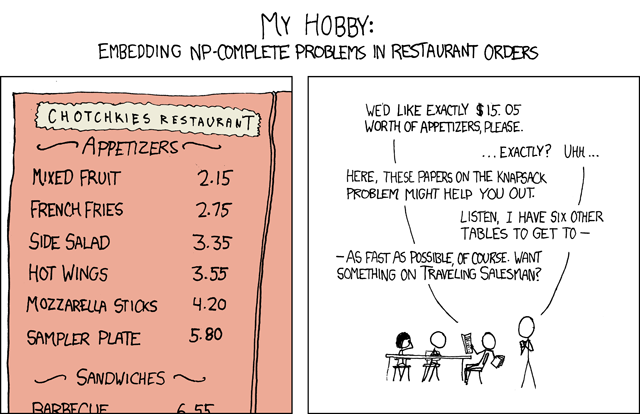
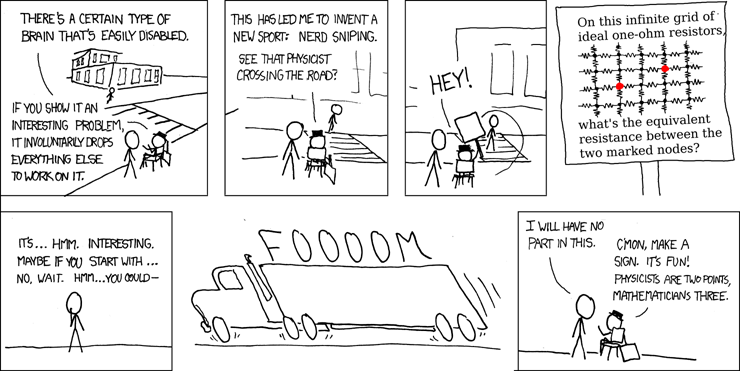
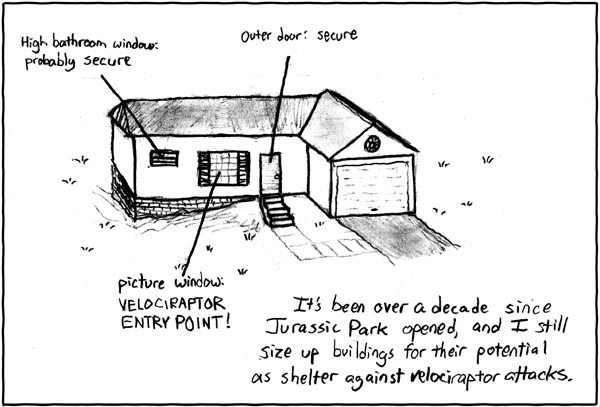
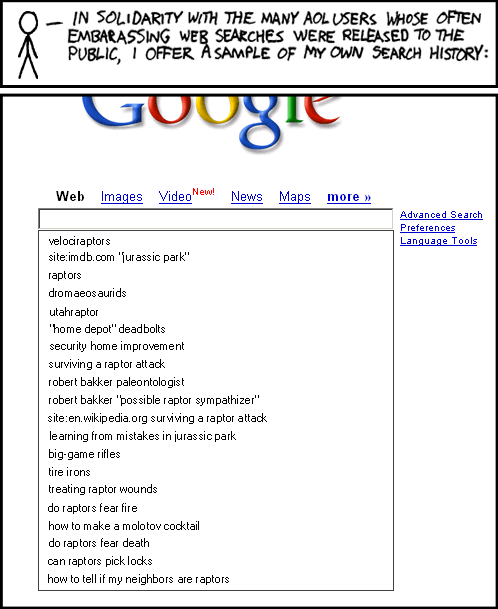
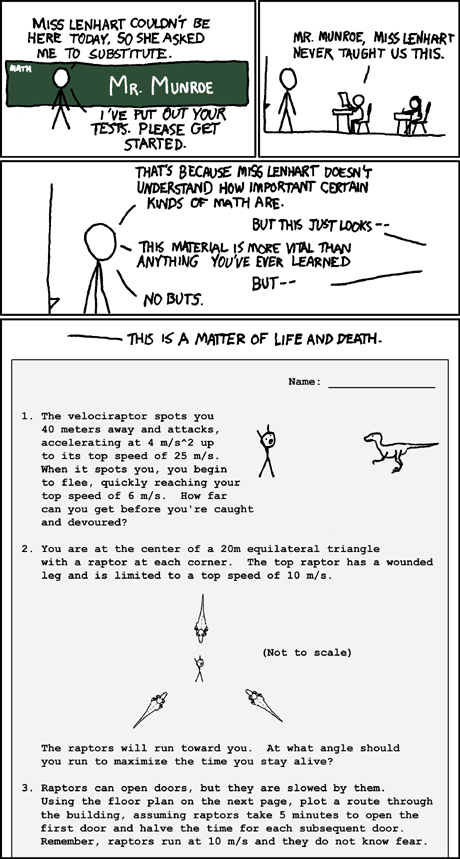
XKCD usually sends me up to the Google bar to look up some math or computer science reference that I just don't get. To be fair, there is a clear warning on the site that the comics occasionally contain "advanced mathematics...which may be unsuitable for liberal-arts majors" It also reminds me to watch out for velociraptors.

Tuesday, January 22, 2008

RE: Life After People

I just finished watching The History Channel's "Life After People," a show I've been looking forward to for a while now. I have a feeling that it was more interesting than accurate - in the way that History/TLC/Discovery programs are these days - and it was no doubt intended to exploit the interest generated by the recent glut of apocalyptic movies such as "Cloverfield", "I Am Legend," and "The Mist." But for all of that it did provide some interesting ideas that I'll be processing in the days to come.


The premise of the show is this: every human being on the planet disappears, simultaneously, overnight. Various experts, researchers, and theorists consider the fate of the planet from 1 day after the event to 10,000 years out. The visuals are a combination of documentary footage of actual abandoned structures and cities - including a fantastic segment inside the Chernobyl Exclusion Zone - and CGI effects of some of the world's best-known structures and cities collapsing into decay.

Overall, I think the producers were pretty optimistic about how quickly Nature will reclaim even large urban centers like Chicago and Manhattan, and pretty pessimistic about how much of human civilization will survive even the first 100 or so years.

The History Channel will air an encore presentation of "Life After People" this Wednesday.

**SPOILERS**

The first fifteen minute segment of the show (covering from the first day without people to a year or so out) were pretty hard for me to watch. I have two small dogs, and all of the experts agreed that those guys will be the first to go. The ones that don't starve to death, locked inside our houses, will most likely be unable to compete successfully for food in the wild. The video for this segment kept cutting back to a family dog trapped in a suburban house, looking hopefully out the front window, drinking the meltwater from the freezer after the power shuts off, and finally tearing open a package of bread for food because, as one expert felt obliged to point out, "dogs can't open cans."

Personally, I think my favorite years are a few hundred years after people: skyscrapers are still standing, but they have been transformed into high-rise forests, with abundant wildlife including, possibly, flying cats. Yes. Flying cats. For me, that thought alone was worth the cost of admission.

**EXTRA SPOILER** About two-thirds through the first segment that dog miraculously escapes from the house. Just in time for the experts to start explaining how he won't be able to survive in the wild.

Thursday, January 17, 2008

Still Thinking About Spook Country

I finished William Gibson's Spook Country last week and I'm still thinking about it; that's unusual for me as I normally just move on when I've finished a novel and save the thinking for when I re-read it in a year or so. But Spook Country has been sticking with me and I think it's because I left the novel without any real sense of what had happened.

Strike that, I understood what had happened, I just wasn't sure why it had. I've been reading some reviews and interviews in an attempt to figure it out. I'm still not sure I've got it, but here's a few of the insights I gleaned:

First, I'm not alone. Most of the professional reviews I read expressed some degree of dissatisfaction with the plot, or, more specifically, with its resolution.

Also, Gibson was right when he guessed, in an interview with Amazon.com, that "I must have readers from 20 years ago who are just despairing of the absence of cyberstuff, or girls with bionic fingernails." A lot of the reader reviews I looked at did seem to be less concerned with the lack of clarity in the plot than the lack of mirror-shaded bionic fingernail girls. For what it's worth, I agree with his follow-up to that statement, "Nothing dates more quickly than an imaginary future. It's acquiring a patina of quaintness even before you've got it in the envelope to send to the publisher." Need proof? Watch Blade Runner (it's just been re-re-released on DVD) and look for the "futuristic" details that Ridley Scott and his production team got wrong or missed completely. (Unless, of course, public phone booths make a major comeback and we all get flying cars within the next ten years.)

Finally, I (and many others judging by the reviews) may have approached Spook Country with too many expectations of what makes a William Gibson novel. In a July 2007 column for scifi.com* John Clute (editor of Science Fiction: The Illustrated Encylopedia, one of my favorite between-novel reads) makes a good argument that Spook Country is actually a comic novel. With that in mind, I can understand why many readers (myself included) felt a little let down by the distinct lack of danger and death (not to mention the aforementioned bionic fingernail girls.) It's one of the more unique takes on the book, and one I look forward to considering during the re-read.

One of the most interesting things I learned, though, actually has little to do with my issues with the book. In that Amazon interview, Gibson says that the social structure in Spook Country (and, by extension, our world today) is actually very close to that of his earliest novel, Neuromancer. Both books, he says, feature characters who are either incredibly wealthy and powerful or poor, powerless and often pushed into quasi-legal or outright criminal behavior by their circumstances.

The hero of Neuromancer has had his career as a "console cowboy" prematurely and surgically terminated by his former employers and takes an offer to commit crimes on behalf of a wealthy and mysterious employer in exchange for the chance to re-enter cyberspace. Hollis Henry, one of Spook Country's protagonists, was the lead singer for a popular indie rock band who lost big when her band broke up and the burst of the dot-com bubble took her savings. She finds herself freelancing for a magazine which may or may not exist, headed by a wealthy and mysterious employer who may be involved in questionable business practices.

Gibson said it best: "the thing about the world of Neuromancer is that there is no middle class. There are only very, very wealthy people and desperately poor, mostly criminal people. It's a very Victorian world, and when I was writing Spook Country I kept running up against that feeling that the world I'm actually trying to predict is becoming more Victorian, not less. Less middle class, more like Mexico, more like Mexico City. And I think that's probably not a good direction." I tend to agree, and upon reading that I immediately flashed back to Neal Stephenson's The Diamond Age, which takes that whole "very Victorian world" idea to its logical conclusion.

I guess I know which book to throw on the re-reading stack next.

*A warning to those who attempt reading John Clute's review: have a dictionary, thesaurus and, perhaps, a machete close at hand. Mr. Clute is without doubt an excellent critic and academician; unfortunately, he also writes like one. There were points where I wondered if I was reading a sci-fi review or somebody's term paper. Seriously, John, who uses the word circumambiate? I don't even think that's a real word, John. Google keeps asking me if I meant "circumambulate." Did you, John? Did you?

Saturday, January 05, 2008

Thursday, November 29, 2007

Coincidence?


So, a year ago I posted this, linking to the video above and commenting on how the setting reminded me of Pattern Recognition, which I had just finished re-reading. This past Tuesday, William Gibson posted this on his blog, linking to the same video on YouTube.

Maybe it's just a coincidence, but it could also mean one of three things:

1) I was correct in my assessment of the Gibsonian nature of that particular video; it just took him a year to find it for himself.

2) William Gibson was vanity-surfing, stumbled across my old post and liked the video.

3) William Gibson reads my blog regularly, liked the video, but held off a year posting his own link so I wouldn't know that he's a fan. Because he's shy, you see.

Are you reading my blog, Bill? It's okay if you are. You can tell me, I won't be mad.

Monday, September 10, 2007

Olafur Eliasson On Wired News

Sam Admires the Round RainbowWired News today has a feature story about a new show by Olafur Eliasson. Eliasson is a contemporary artist who works with light and projection. One of his best-known works is The Weather Project, in which he created an artificial sun. As I occasionally dabble in lighting design for the theatre, I'm always interested to read about him.

I first saw his work when the Hirshhorn Museum in DC called to ask for help repairing a Strand (Quartzcolor, actually, but that's another story) OneLight fresnel spotlight. It was part of his piece Round Rainbow which was being shown in their Refract, Reflect, Project exhibit.

Since the Smithsonian wasn't all too keen to ship part of their art collection up to Frederick, I piled into the truck with Sam (our head field-service technician, seen above admiring the "Round Rainbow") and we headed for the city.

Sam was able to get the fixture working again and the staff offered to let us see how it was used in the piece, and show us around the rest of the exhibit while everything was still being installed.


The QuartzColor OneLight in the Restoration Shop of the Hirshhorn MuseumLighting is an essential part of my work, so I naturally get excited by the sort of art they were showing off in this exhibit. There were weird projected-color pieces, light-as-sculpture pieces, and a wheelbarrow constructed of what appeared to be dozens of fluorescent tubes. I'll admit that I still don't get the wheelbarrow piece but I thoroughly enjoyed the Thomas Wilfred "lumia," especially given that I was able to look behind the screen and see the genuinely antique equipment that created the projections. The public generally never gets to see that part of a Wilfred work.

Eliasson, on the other hand, makes a point of keeping the "gear" in plain view, which I love. For me, part of the fun of a piece like "Round Rainbow," is walking into a gallery and first being stunned by the light dancing around the space and then getting to see how he pulled it off. Refract, Reflect, Project has since closed, but there's lots of good images of Eliasson's work on the web, and Take Your Time, his current show at San Francisco's Museum of Modern Art, will be coming to New York in April of 2008.

link to Wired News Story

Thursday, July 19, 2007

Checkers Solved! Can Mouse Trap Be Far Behind?

19:00 19 July 2007
NewScientist.com news service
Justin Mullins

The ancient game of checkers (or draughts) has been pronounced dead. The game was killed by the publication of a mathematical proof showing that draughts always results in a draw when neither player makes a mistake. For computer-game aficionados, the game is now "solved"

Draughts is merely the latest in a steady stream of games to have been solved using computers, following games such as Connect Four, which was solved more than 10 years ago.

The computer proof took Jonathan Schaeffer, a computer-games expert at the University of Alberta in Canada, 18 years to complete and is one of the longest running computations in history.

In honor of his achievements, Mr. Schaeffer has been appointed to the University's prestigious Cracker Barrel Chair as Professor of Jes' Sitting on the Front Porch Playin' Checkers, Y'all.

In related news, how the heck do I get a job where I play checkers for 18 years?!

link via Boing Boing

Tuesday, June 12, 2007

Jeff Victor's Pop Culture Bubbleheads

Over at his blog Wicked Crispy, Jeff Victor is showcasing his extra-cute "bubblehead" character portraits. They're mostly taken from Star Wars, but there's other movie and comics referenced, as well as some examples of Jeff's commercial illustration work.

I'm loving his take on George Lucas' characters, although the portraits of humans all look like South Park characters to me.

Tuesday, May 29, 2007

The First Pogo Possum Strip

My dad introduced me to the Pogo comics, and I quickly fell in love with Walt Kelly's style of drawing, his characters' outrageous dialects, and the often equally outrageous lettering styles that accompanied them.
Recently, I learned that Fantagraphics will be publishing a complete collection of Pogo daily and Sunday comics in the near future. And then, today, Drawn! tells me that there's a hi-res scan of the first ever Pogo strip up at the Arflovers blog. Click on Li'l Ol' Pogo over there for the link.

Thursday, May 24, 2007

Backpack Penguin!


Backpack Penguin!

Backpack Penguin!
Backpack Penguin! by: me
Backpack Penguin!

Wednesday, May 23, 2007

Lolz.


I've been meaning to post this comic from the always excellent and nerdy webcomic XKCD. (Seriously, one of the only webcomics I've found with a decent funny : nerdy ratio.)

I have to admit, I feel a bit guilty for enjoying the whole Lolcat / Caturday phenomenon ... but that doesn't stop me from squandering hours of perfectly good internet on sites like I Can Has Cheezburger? and CuteOverload.

Also: lolrus

Wednesday, May 16, 2007

Thank You 120 Minutes

Last post I mentioned how MTV's 120 Minutes introduced me to a lot of great music back in the days before the Interweb. Out of curiosity, I dug up the playlists from my junior and senior years of high school to see just how much music I would have missed out on had I actually gone to bed at a decent hour on Sundays.

Quite a lot, as it turns out. Here's some of my favorites, with links to videos where I could find them. I can remember making some of my first mix tapes with these songs, patching the audio output from my parents' VCR into my boom box and recording everything onto glorious Maxell 90-minute cassettes. Fresh.

The Sisters of Mercy: I loved goth-rock before I even knew what goth was. "Lucretia My Reflection" aired in July of '88. Almost twenty years later, I still don't know what the lyrics are supposed to mean.

That same episode featured "Peek-a-Boo" by Sioxsie and the Banshees. I think I bought the cassette of Peepshow the next week.

The video for Billy Bragg's excellent "Waiting for the Great Leap Forwards" aired in June. This YouTube video is actually for "There is Power in a Union" from Talking With the Taxman About Poetry. It's worth watching for the AFL-CIO organizer in full cheerleader drag. Due to the relative obscurity of Bragg here in the States (or, at least, in Scenic Western Maryland) I didn't get my hands on an album of his until two years later, when I stumbled on copies of Worker's Playtime and Taxman in the discount bin of the Virgin megastore in London.

The Primitives' "Crash" was another July '88 offering - I must have been up late a lot that July. Apparently, it was remixed for the movie Dumb and Dumber; something I only just learned as I've been steadfastly avoiding seeing any part of that movie since it came out.

Finally, "Reptile", by The Church, aired in August of '88. I think I may have actually seen the video for "Under the Milky Way" earlier that year, but I can't prove it. Both songs together got me to pony up for a copy of Starfish in time for the back-to-school moping season. (I lettered in Mope.)

Friday, May 11, 2007

The Audacity Project

I'm slooowly working my way through a box of my old cassette tapes from the 80s and 90s, converting them to MP3 by way of a neat, free program called Audacity. Briefly, it's a program that allows me to record the input from a borrowed cassette player (thanks, Dad! I'll return it someday soon, I promise!) as a .wav file on my hard drive. I record each side of a tape as its own file, then go back through and chop it up into individual tracks. For the most part I've been happy with the results, although albums that feature tracks fading into each other can be tough to split up. Into the Labyrinth by Dead Can Dance, for example, was a royal pain.

I just finished converting one of my favorite tapes from my early college days, Only Life by The Feelies. I remember hearing "Away" for the first time on 120 Minutes, back in 1989 or so. That show lead me to a lot of good music back in the days before the Interwub...but that's a different post. Anyway, here's a link to the MP3 of "Away." Illegal, I guess, so check it out before The Man shuts me down.

Next up: Floodland by The Sisters of Mercy. Bring on the gothy goodness!

Tuesday, December 05, 2006

Making Comics - Chapter 5 1/2 Is Finally Up!

Those of us who purchased Scott McCloud's excellent "Making Comics" have been anxiously awaiting "Chapter 5 1/2," the promised online supplement that goes into detail about webcomics. I learned today that it's finally up over at Scott's site.

Friday, November 10, 2006

Concrete Screen


Despite the web site's Star-Trekky promise of "transparent concrete", it’s basically just a slab of concrete with fiber optic cables embedded within.

Still pretty cool, though, and because the cables can transmit natural light as easily as a projected image, it's conceivable that it could be used to install “windows” in below-ground offices and apartements.